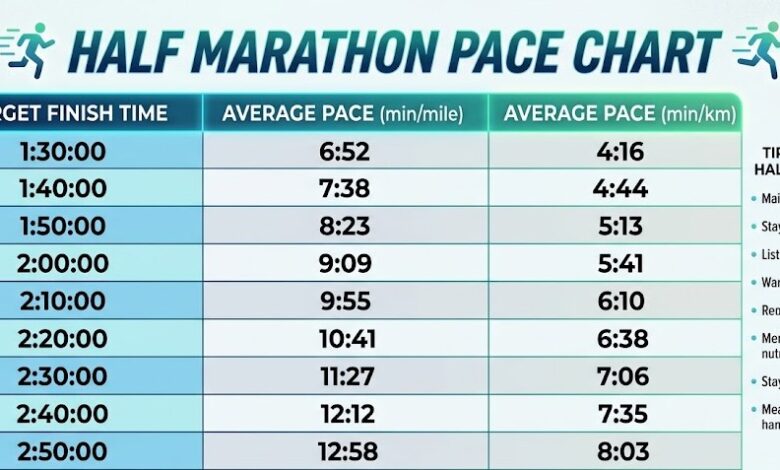
Pacing is the foundation of a successful half marathon because it directly controls how efficiently you use your energy over 21.1 kilometers. The half marathon pace chart helps runners understand exactly how fast they should run to reach a specific finish time without burning out early. Without a pacing plan, many runners start too aggressively, driven by excitement, only to struggle in the later stages of the race when fatigue sets in.
A well-structured pacing strategy ensures that energy is distributed evenly from start to finish. Instead of guessing your speed during the race, you follow a planned rhythm that matches your fitness level and goal. This approach reduces the chances of hitting the wall and improves your ability to maintain consistent performance. In endurance running, consistency almost always beats short bursts of speed followed by exhaustion, making pacing one of the most critical elements for success.
Understanding the Half Marathon Pace Chart
A half marathon pace chart is a simple but powerful tool that converts your target finish time into an exact running pace per mile or per kilometer. It removes uncertainty from your training by giving you a clear number to follow during workouts and on race day. Instead of guessing whether you are running too fast or too slow, the chart provides a structured reference that aligns your speed with your goal time.
This chart is especially useful because it connects your overall race objective with practical, real-time pacing. For example, if your goal is to finish in 2 hours, the chart tells you the exact pace you must maintain consistently throughout the race. This allows runners to train smarter by practicing at or near their target pace, which improves endurance, rhythm, and confidence. Over time, it becomes easier to recognize what your goal effort actually feels like, making race execution much more controlled and efficient.
Pace Chart by Finish Time (Beginner to Advanced)
A half marathon pace chart becomes most useful when it is broken down by finish times, allowing runners to clearly see what pace is required for different performance levels. This section helps you match your fitness goal with an exact per-mile or per-kilometer speed, making your training more focused and realistic. Whether you are aiming just to finish or targeting a personal record, these benchmarks give you a clear direction.
For beginners, finish times usually range between 2:15 to 2:30 hours, while intermediate runners often aim for sub-2:00 or 1:45. Advanced runners may target 1:30 or faster, which requires strong endurance and disciplined pacing. Each finish time corresponds to a specific pace that must be maintained consistently throughout the race. Understanding these differences helps runners set achievable goals and avoid unrealistic expectations that could lead to burnout or injury during training.
Training Zones and How They Connect to Pace
Training zones are closely linked with the half marathon pace chart because they help runners understand how different intensities contribute to race performance. Each zone represents a specific effort level, from easy recovery runs to hard threshold sessions, and together they build the endurance needed for a half marathon. When you know your target pace, you can match it with the correct training zone to improve both speed and stamina efficiently.
The most important zone for half marathon runners is the threshold or tempo zone, which sits just below race effort. Training in this zone teaches your body to sustain a strong but controlled pace over longer distances. Easy runs support recovery and aerobic development, while long runs build endurance and mental toughness. When all these zones are aligned with your pace chart, your training becomes more structured, helping you perform consistently on race day without overtraining or underestimating your effort.
Common Pacing Mistakes Runners Make
One of the most frequent issues runners face is ignoring their half marathon pace chart during the early part of the race. Many start too fast due to excitement, crowd energy, or adrenaline, which leads to a rapid drop in energy later. This mistake often results in fatigue around the final 5–7 kilometers, where maintaining pace becomes extremely difficult.
Another common problem is inconsistent pacing throughout the race. Some runners alternate between running too fast and too slow, which wastes energy and prevents them from finding a steady rhythm. Without a clear pacing structure, it becomes easy to lose control of effort levels. A proper pace chart helps avoid these mistakes by giving runners a clear, steady target to follow, ensuring energy is used efficiently from start to finish.
How to Use a Pace Chart for Race Day Strategy
On race day, the half marathon pace chart becomes your most reliable guide for managing effort and staying on track with your goal time. Instead of running based on emotion or crowd energy, you follow a pre-planned pace that matches your target finish. This helps you avoid starting too fast and ensures that your energy is distributed evenly across the full 21.1 kilometers.
A smart race strategy usually begins with a controlled first few kilometers, slightly slower than your target pace, allowing your body to settle into rhythm. Once comfortable, you shift into your goal pace and maintain it consistently through the middle section of the race. In the final kilometers, experienced runners may slightly increase effort if energy allows. This structured approach reduces fatigue, improves efficiency, and gives you a stronger finish compared to unplanned pacing.
Expert Tips to Improve Half Marathon Performance
Improving your half marathon performance requires more than just running regularly; it demands structured training guided by a half marathon pace chart. One of the most effective strategies is practicing your goal pace during weekly workouts so your body becomes familiar with the exact effort needed on race day. This builds both physical endurance and mental confidence, making it easier to maintain steady pacing under pressure.
Another important tip is focusing on long runs and tempo sessions, which develop stamina and teach your body to sustain effort over time. Long runs build endurance capacity, while tempo runs improve your ability to hold a challenging but controlled pace. Recovery is equally important, as proper rest allows your muscles to adapt and grow stronger. When all these elements work together with a clear pacing strategy, your overall race performance becomes more efficient, controlled, and consistent.
Conclusion
The half marathon pace chart is an essential tool for any runner who wants to train smarter and race more efficiently. It removes uncertainty by giving you a clear structure for pacing, helping you understand exactly how fast you need to run to reach your goal time. When used correctly, it improves consistency, prevents early burnout, and builds confidence during both training and race day.
By combining proper pacing with structured training zones, long runs, and tempo workouts, runners can significantly improve their endurance and performance. The key is discipline—sticking to your planned pace instead of reacting to race-day emotions or external pressure. Over time, this approach leads to stronger finishes and better overall results.
FAQs
1. What is a half marathon pace chart used for?
It helps runners determine the exact pace needed per mile or kilometer to achieve a specific finish time.
2. How do beginners use a pace chart?
Beginners use it to set realistic goals and train at a consistent pace that matches their fitness level.
3. Is it better to start slow or fast in a half marathon?
Starting slightly slower and building into your target pace is usually more effective and reduces fatigue.
4. Can a pace chart improve race performance?
Yes, it helps maintain consistency, improves energy management, and increases the chances of a strong finish.
For More Update and Stories Visit: Hollywood Times