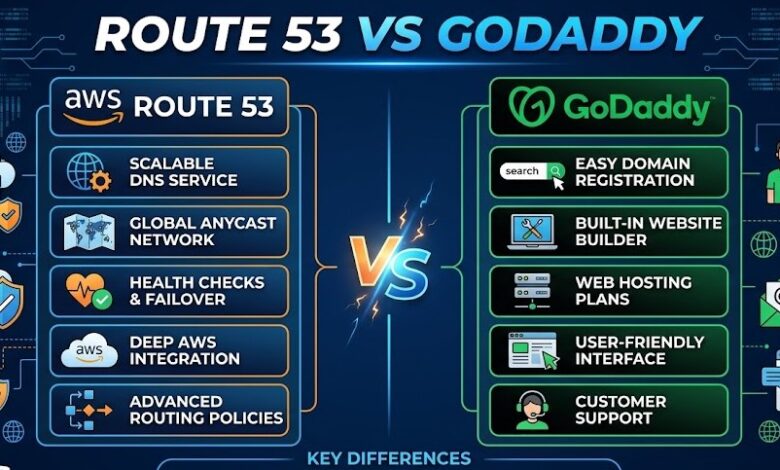
Choosing the right domain and DNS service plays a major role in how a website performs, loads, and scales over time. When comparing route 53 vs godaddy, it is important to understand that both platforms serve the same basic purpose of connecting a domain name to a website, but they are built for completely different types of users. Route 53 is designed for cloud-based applications and large-scale systems that need high performance, global reach, and advanced traffic control. GoDaddy, on the other hand, focuses on simplicity and ease of use, making it a popular choice for beginners, bloggers, and small business owners who want a quick and straightforward setup without dealing with technical complexity.
What is Amazon Route 53?
Amazon Route 53 is a cloud-based Domain Name System (DNS) service developed by Amazon Web Services (AWS) that is designed to handle highly scalable and reliable internet traffic routing. It is mainly used by developers, enterprises, and cloud applications that require advanced performance, global availability, and fine control over how users are directed to their websites or services. Unlike basic DNS tools, Route 53 offers intelligent routing features such as latency-based routing, geolocation routing, and failover mechanisms, which help ensure users are always connected to the fastest and most reliable server available. It is deeply integrated with other AWS services, making it a powerful option for businesses running applications in the cloud that demand high uptime and low latency across different regions of the world.
What is GoDaddy DNS and Domain Services?
GoDaddy is a widely used domain registrar and web services provider that offers DNS management, domain registration, hosting, and website building tools in one platform. It is designed primarily for beginners, small businesses, and individuals who want an easy way to get their website online without dealing with complex technical settings. The DNS system in GoDaddy allows users to manage basic records like A, CNAME, and MX records through a simple dashboard, making it accessible even for users with no technical background. Unlike more advanced systems, GoDaddy focuses on convenience and all-in-one functionality rather than deep customization or enterprise-level routing features, which is why it is often chosen for simple websites, blogs, and small online stores.
Key Feature Comparison
When comparing route 53 vs godaddy, the biggest difference comes down to features and flexibility. Amazon Route 53 is built for advanced DNS management, offering features like latency-based routing, geolocation routing, health checks, and automatic failover systems. These tools allow businesses to control how and where users are directed, ensuring better performance and reliability for global audiences. It is especially useful for cloud-based applications that require precise traffic management and high availability across multiple regions.
GoDaddy, in contrast, focuses on simplicity and ease of use rather than advanced control. It provides all the essential DNS features such as A records, CNAME records, MX records, and basic domain management tools. While this is enough for most simple websites and small businesses, it does not offer the same level of traffic routing intelligence or cloud integration that Route 53 provides. This makes GoDaddy more suitable for beginners, whereas Route 53 is better suited for developers and large-scale systems that need deeper control over DNS behavior.
Performance and Reliability
Performance is one of the most important factors when comparing route 53 vs godaddy, especially for websites that target a global audience. Amazon Route 53 is built on Amazon’s worldwide cloud infrastructure, which means it operates through multiple DNS servers distributed across different regions. This setup helps reduce latency and ensures faster response times for users regardless of their location. It also includes built-in health checks and failover systems, which automatically redirect traffic to a working server if one becomes unavailable, improving uptime and reliability for critical applications.
GoDaddy also offers reliable DNS services, but its performance is more focused on standard websites and smaller-scale projects. While it is stable for most everyday use cases, it does not provide the same level of global optimization or advanced redundancy as Route 53. For users running simple websites, GoDaddy’s performance is usually sufficient, but for businesses that depend on high availability and fast global access, Route 53 has a clear advantage in both speed and reliability.
Pricing Differences
Pricing is another major factor in the route 53 vs godaddy comparison, and both platforms follow very different models. Amazon Route 53 uses a pay-as-you-go pricing structure, where users are charged based on the number of hosted zones and DNS queries handled each month. This model is highly flexible and can be cost-effective for both small and large applications, but costs may increase as traffic grows significantly. It is designed to scale with usage, which makes it suitable for businesses that experience fluctuating or global traffic patterns.
GoDaddy, on the other hand, follows a more traditional fixed pricing model. Users typically pay an annual fee for domain registration, and DNS management is often included as part of bundled services such as hosting or email packages. This makes GoDaddy easier to understand for beginners since costs are predictable and upfront. However, while it may seem simpler, it does not offer the same level of cost optimization for high-traffic or enterprise-level websites that Route 53 provides through its usage-based system.
Ease of Use and Setup
Ease of use is one of the biggest deciding factors in the route 53 vs godaddy comparison, especially for beginners. GoDaddy is widely known for its simple and user-friendly interface, which allows users to register domains, configure DNS settings, and launch websites with minimal technical knowledge. Everything is presented in a clean dashboard, and most actions can be completed in just a few clicks, making it ideal for beginners, small business owners, and bloggers who want a quick setup without dealing with complex configurations.
Amazon Route 53, however, is more technical and requires a basic understanding of AWS services. Setting up DNS records, configuring routing policies, or linking services like EC2 or S3 involves working within the AWS ecosystem, which can be overwhelming for new users. While it offers far more control and flexibility, it is clearly designed for developers and IT professionals rather than casual users. This makes GoDaddy the easier option for beginners, while Route 53 is better suited for users who are comfortable with cloud infrastructure management.
Security and Scalability
Security and scalability are key areas where the route 53 vs godaddy comparison becomes very important for long-term website planning. Amazon Route 53 is built with enterprise-level security in mind and integrates directly with AWS security infrastructure. It supports DNSSEC (Domain Name System Security Extensions), which helps protect against DNS spoofing and attacks. In addition, its scalable architecture allows websites to handle massive traffic spikes without downtime, making it a strong choice for growing businesses and global applications that require consistent performance under heavy load.
GoDaddy also provides standard security features such as domain protection, SSL certificates, and basic DNS security options. However, its scalability is more limited compared to Route 53, especially for applications that require complex traffic routing or global load balancing. While GoDaddy is secure enough for personal websites and small businesses, it does not offer the same enterprise-grade scalability or advanced security integrations that AWS provides. This makes Route 53 a better fit for high-growth platforms, while GoDaddy remains suitable for simpler use cases.
Conclusion
When comparing route 53 vs godaddy, the final choice depends entirely on your website’s purpose and technical needs. Amazon Route 53 clearly stands out as the more powerful and scalable DNS solution, offering advanced routing features, global performance optimization, and deep integration with AWS services. It is best suited for developers, enterprises, and businesses that require high availability, low latency, and full control over their traffic management. Its flexibility makes it a strong long-term solution for complex and growing digital platforms.
GoDaddy, on the other hand, remains a solid choice for beginners and small businesses who want simplicity and convenience. It provides an easy way to register domains, manage DNS settings, and launch websites without technical expertise. While it lacks advanced routing and enterprise-level features, it is still reliable for basic websites, blogs, and small online stores.
In conclusion, if you need simplicity and quick setup, GoDaddy is the better option. But if your priority is performance, scalability, and advanced DNS control, Route 53 is the stronger and more future-ready solution.
FAQs
1. What is the main difference between Route 53 and GoDaddy?
The main difference is that Route 53 is a cloud-based advanced DNS service designed for scalability and performance, while GoDaddy is a beginner-friendly domain registrar and hosting provider with basic DNS features.
2. Is Route 53 better than GoDaddy for websites?
Route 53 is better for large-scale, high-traffic, or cloud-based websites, while GoDaddy is better for simple websites, blogs, and small businesses that need easy setup.
3. Can I use GoDaddy domain with Route 53?
Yes, you can connect a GoDaddy-registered domain to Amazon Route 53 by updating your nameservers, allowing you to use AWS DNS services while keeping your domain with GoDaddy.
4. Which is cheaper, Route 53 or GoDaddy?
GoDaddy usually has fixed yearly pricing, which is easier to predict, while Route 53 uses a pay-as-you-go model that can be cheaper for low traffic but scale with usage over time.
For More Update and Stories Visit: Hollywood Times