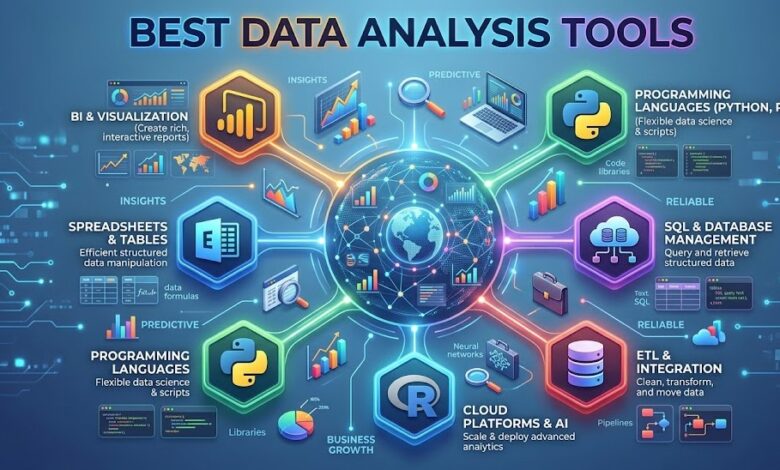
In today’s fast-paced digital economy, businesses generate massive amounts of data every second, and making sense of this information has become critical for survival and growth. This is where best data analysis tools play a vital role, helping organizations transform raw data into meaningful insights that support better decision-making. Companies no longer rely on guesswork; instead, they depend on data-driven strategies to understand customer behavior, market trends, and operational efficiency. Without these tools, businesses risk falling behind competitors who use analytics to move faster and smarter in the market.
Another important reason these tools matter is their ability to improve accuracy and reduce human error in decision-making processes. Traditional methods of analyzing data manually are not only time-consuming but also prone to mistakes, especially when dealing with large datasets. Modern data analysis platforms automate much of this process, allowing analysts and business leaders to focus on interpretation rather than data handling. As a result, organizations can quickly identify opportunities, reduce risks, and make informed strategic decisions that directly impact growth and profitability.
Top Best Data Analysis Tools in 2026
The landscape of best data analysis tools in 2026 is highly diverse, offering solutions for beginners, professionals, and enterprise-level organizations. Among the most widely used platforms are Microsoft Power BI, Tableau, Python-based analytics libraries, Apache Spark, and Google Looker Studio. Each of these tools serves a different purpose, from simple dashboard creation to advanced big data processing. Businesses choose these tools based on their specific needs, such as visualization, machine learning, or real-time analytics, making the ecosystem flexible and powerful.
What makes these tools stand out is their ability to handle both structured and unstructured data efficiently while providing actionable insights in real time. For example, Power BI and Tableau are widely used for interactive dashboards that help decision-makers understand complex datasets at a glance, while Python and Spark are preferred by data scientists for deeper statistical and predictive analysis. Together, these tools form the backbone of modern analytics systems, enabling companies to stay competitive in a data-driven world.
Comparison of Popular Data Analysis Tools
When evaluating the best data analysis tools, it becomes clear that each platform has its own strengths and limitations depending on use cases. Tools like Microsoft Power BI and Tableau are highly favored for data visualization and business intelligence because they allow users to create interactive dashboards without requiring deep coding knowledge. On the other hand, Python and its libraries such as Pandas and NumPy are more suitable for advanced users who need flexibility in data manipulation, statistical modeling, and machine learning integration. This difference makes tool selection highly dependent on user expertise and project requirements.
| Tool | Best For | Skill Level | Key Strength |
|---|---|---|---|
| Power BI | Business dashboards | Beginner to Intermediate | Easy integration with Microsoft tools |
| Tableau | Data visualization | Intermediate | Advanced interactive visuals |
| Python | Data science & ML | Advanced | Flexibility & customization |
| Apache Spark | Big data processing | Advanced | Handles large-scale datasets |
| Looker Studio | Reporting | Beginner | Free and cloud-based |
Overall, while no single tool is perfect for every situation, the combination of these platforms allows organizations to build a complete analytics ecosystem. Businesses often use multiple tools together to cover everything from data collection to visualization and predictive analysis, ensuring they get the most value from their data assets.
Best Tools for Beginners
For those just starting their journey into data analytics, choosing the best data analysis tools can feel overwhelming due to the wide variety of options available. However, beginners should focus on tools that are easy to learn, require minimal coding, and offer strong visual interfaces. Microsoft Excel remains one of the most popular starting points because it allows users to organize, analyze, and visualize data using simple functions and built-in charts. Alongside Excel, Google Looker Studio is another beginner-friendly option that provides cloud-based reporting without any cost, making it ideal for students and small businesses.
Another excellent entry-level tool is Microsoft Power BI, which combines ease of use with powerful dashboard capabilities. It enables beginners to connect different data sources and build interactive reports with drag-and-drop features. Similarly, Tableau Public offers a free version that helps new users understand data visualization concepts in a practical way. These tools not only build foundational skills but also prepare users for more advanced analytics platforms in the future. By starting with beginner-friendly tools, learners can gradually build confidence and transition into more complex data environments.
Advanced Tools for Data Scientists
For professionals working in deep analytics, machine learning, and large-scale data processing, the best data analysis tools go far beyond simple dashboards. Data scientists rely heavily on programming-based and high-performance platforms such as Python, Apache Spark, R, and SAS. These tools are designed to handle complex computations, build predictive models, and process massive datasets that traditional BI tools cannot manage efficiently. Python, in particular, has become the industry standard due to its rich ecosystem of libraries like Pandas, Scikit-learn, and TensorFlow, which support everything from data cleaning to advanced AI modeling.
Apache Spark is another powerful tool widely used in big data environments where speed and scalability are critical. It allows distributed data processing across clusters, making it ideal for companies dealing with terabytes or even petabytes of data. Similarly, SAS remains a trusted solution in industries like healthcare and finance due to its strong statistical analysis capabilities and reliability in regulated environments. These advanced tools require technical expertise, but they offer unmatched flexibility and depth, enabling data scientists to uncover insights that drive innovation, automation, and strategic decision-making at a higher level.
How to Choose the Right Tool
Selecting the best data analysis tools depends largely on your goals, experience level, and the type of data you are working with. There is no single “perfect” tool for everyone, because each platform is designed to solve different problems. For example, beginners may prioritize ease of use and visual interfaces, while advanced users focus on scalability, coding flexibility, and machine learning capabilities. Understanding your requirements is the first step in narrowing down the right solution.
Another important factor is the nature of your work environment and data size. If you are handling small to medium datasets for reporting, tools like Excel or Power BI may be sufficient. However, if you are working with large-scale datasets or real-time data streams, then Apache Spark or Python-based solutions are more appropriate. Budget also plays a role, as some tools are free while others require expensive enterprise licenses. By carefully evaluating your technical skills, project complexity, and long-term goals, you can choose a tool that not only meets your current needs but also supports future growth.
Future of Data Analysis Tools (AI-Driven Analytics)
The future of the best data analysis tools is rapidly shifting toward artificial intelligence and automation, where systems are becoming smarter, faster, and more predictive. Instead of manually analyzing datasets, modern tools are now integrating AI capabilities that can automatically detect patterns, generate insights, and even suggest business actions. This transformation is making data analytics more accessible to non-technical users while significantly improving decision-making speed and accuracy across industries.
Another major trend is the rise of real-time analytics powered by cloud computing and machine learning models. Businesses are increasingly adopting AI-driven platforms that can process continuous data streams from websites, apps, and IoT devices. These advanced systems help organizations predict customer behavior, detect fraud, and optimize operations instantly. As AI continues to evolve, future data analysis tools will become even more intuitive, allowing users to interact with data through natural language queries instead of complex coding or manual reporting.
Conclusion
In conclusion, the demand for the best data analysis tools continues to grow as businesses become more data-driven and competitive in the modern digital landscape. From beginner-friendly platforms like Excel and Google Looker Studio to advanced solutions like Python, Apache Spark, and SAS, each tool plays a unique role in transforming raw data into meaningful insights. The right combination of tools can significantly improve decision-making, efficiency, and business performance. As technology continues to evolve, especially with the integration of AI, data analysis will become even more powerful and accessible for users at all levels.
Ultimately, choosing the right tool depends on your goals, technical skills, and the complexity of your data needs. Whether you are a student, a business analyst, or a data scientist, mastering these tools can open doors to high-demand career opportunities and smarter business strategies. The future belongs to those who can effectively understand and utilize data to drive innovation and growth.
FAQs
1. What are the best data analysis tools for beginners?
Beginners can start with Excel, Google Looker Studio, and Power BI because they are easy to use and require minimal coding.
2. Which data analysis tool is best for big data?
Apache Spark is one of the best tools for handling large-scale and real-time data processing.
3. Is Python good for data analysis?
Yes, Python is one of the most powerful tools for data analysis due to its libraries like Pandas, NumPy, and Scikit-learn.
4. Are data analysis tools difficult to learn?
Some tools are easy for beginners, while advanced tools require coding knowledge. With practice, most tools become manageable over time.
For More Update and Stories Visit: Hollywood Times