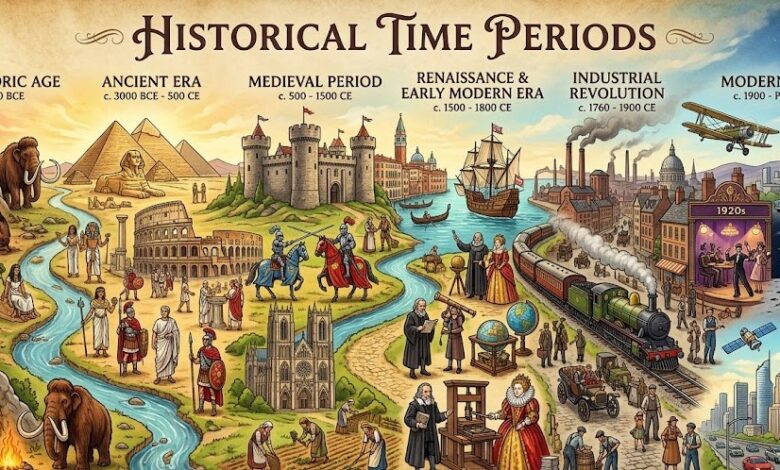
The prehistoric era represents the earliest stage of historical time periods, long before written records were created. During this time, human beings lived in small groups and depended entirely on nature for survival. They hunted animals, gathered plants, and slowly learned how to adapt to changing environments. This era is considered the foundation of human development because it marks the beginning of tool use, fire control, and early communication methods.
In this period, life was extremely simple but also very challenging. Humans gradually evolved from nomadic lifestyles to more settled communities by the end of the Stone Age. The development of basic stone tools and early forms of art, such as cave paintings, shows that humans were beginning to think creatively and socially. This era is divided into Paleolithic, Mesolithic, and Neolithic phases, each showing important progress in survival techniques and social organization.
Ancient Civilizations and Early Societies
The ancient civilizations and early societies phase marks a major turning point in historical time periods, as humans began forming structured communities and developing written communication. Civilizations such as Mesopotamia, Egypt, the Indus Valley, China, and Mesoamerica played a key role in shaping early human culture. Writing systems, laws, and organized governments emerged during this time, allowing societies to grow in complexity and stability.
This era also introduced advancements in agriculture, architecture, and trade. People built cities, created irrigation systems, and developed religious and cultural traditions that influenced future generations. The invention of writing, such as cuneiform and hieroglyphics, allowed humans to record history for the first time. These early societies laid the groundwork for modern civilization by establishing systems of governance, economy, and education.
Classical Era and the Rise of Empires
The classical era is one of the most influential historical time periods, known for the rise of powerful empires such as Greece and Rome. This period saw the development of democracy, philosophy, and advanced political systems. Greek thinkers like Socrates, Plato, and Aristotle shaped intellectual traditions that still influence modern education and governance today.
At the same time, the Roman Empire expanded across Europe, North Africa, and parts of Asia, creating a vast network of roads, laws, and infrastructure. This era also witnessed significant cultural and scientific achievements in mathematics, architecture, and engineering. The classical period laid the foundation for Western civilization and introduced ideas of citizenship, law, and organized state systems that continue to exist in modern societies.
Medieval Period and Feudal Systems
The medieval period, also known as the Middle Ages, is a significant phase in historical time periods that followed the fall of the Roman Empire. During this time, Europe was organized into a feudal system where kings, lords, knights, and peasants had clearly defined roles. Life was largely rural, and agriculture formed the backbone of the economy.
This era also saw the rise of powerful religious institutions and the spread of Christianity and Islam across different regions. Castles, kingdoms, and trade routes developed, connecting different parts of the world. Despite being once called the “Dark Ages,” modern historians recognize this period as a time of cultural growth, technological innovation, and social restructuring that prepared the world for the modern age.
Early Modern Age of Exploration and Change
The early modern age marks a transformative stage in historical time periods, beginning around the 15th century. This era is defined by global exploration, scientific discovery, and cultural exchange. Explorers from Europe traveled across oceans, discovering new lands and establishing trade routes that connected continents for the first time.
This period also includes the Renaissance, a cultural movement that revived art, science, and literature. Major scientific breakthroughs challenged old beliefs and introduced a new way of thinking based on observation and experimentation. The early modern age reshaped global history by expanding trade networks and encouraging intellectual progress across different societies.
Modern Era and Industrial Transformation
The modern era is a crucial stage in historical time periods, marked by rapid industrialization and technological advancement. The Industrial Revolution transformed economies from agriculture-based systems to machine-driven production. Factories, railways, and new inventions changed how people lived and worked.
This era also witnessed major political changes, including revolutions, the rise of nation-states, and global conflicts such as World War I and World War II. Technological innovations in electricity, transportation, and communication reshaped society. The modern era laid the foundation for the highly industrialized and interconnected world we live in today.
Contemporary World and Digital Revolution
The contemporary world represents the latest phase of historical time periods, beginning after World War II and continuing into the present day. This era is defined by globalization, technological innovation, and rapid digital transformation. Computers, the internet, and mobile technology have completely changed how humans communicate and work.
In this period, societies have become more interconnected than ever before. Global trade, international organizations, and digital platforms play a major role in daily life. Advancements in artificial intelligence, space exploration, and medical science continue to shape the future. The contemporary era reflects the fastest pace of change in human history.
Conclusion
The study of historical time periods helps us understand the journey of humanity from early survival to modern technological civilization. Each era contributed important developments that shaped the world we live in today. From prehistoric tools to digital technology, human progress has been continuous and transformative.
FAQs
1. What are historical time periods?
They are divisions of history used to organize and understand major stages of human development.
2. Why is the prehistoric era important?
It marks the beginning of human life and early survival techniques.
3. What defines the modern era?
Industrialization, global conflicts, and technological advancement.
4. What is the contemporary period known for?
Digital technology, globalization, and rapid scientific progress.
For More Update and Stories Visit: Hollywood Times